Each print is designed, vectored and printed by Nytom, this insures him his design, color and size is of his own discretion.
The Somerset Velvet paper is of the highest quality paper possible. Each print is printed by order only, and is shipped flat on acid free mate board and acid free sleeve.
For maximum print longevity, Epson highly recommends displaying your prints mounted double mated under glass. This protects them from discoloration caused by exposure to air and extends the life of the paper and its coating.
“Children Born of the Sun” has been added to your cart. View cart
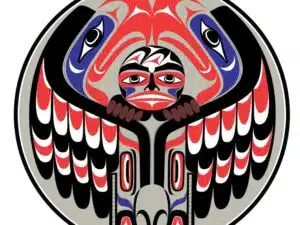
‘Thunderbirds’ is a drum design that came forth years ago. Nytom has revisited it often with the intent of creating a limited-edition print. At a potlatch in the late 1980s, Mowachaht leader Jerry Jack asked to have a design painted on his drum. It was natural to conceive a design representative of his love for his three children and their love and respect for him. The children felt much pride in their father and his efforts to keep the culture alive, and they were always ready to sing and dance at their father’s request. Even though years have passed and his children are now adults, they are just as dedicated as their father to keeping the culture alive.
In the territory of the Makah people, their lands were occupied by five separate villages. On the ocean, their property reached as far as the eye could see. The purpose of such a large domain was to feed the people of the five villages all year long. These included De-aht (Neah Bay), Ozette, Ba’eyda, Tsoo-Yess, and Why-atch. To occupy such territory was a big responsibility, having access to the ocean and the broad Strait between home and Vancouver Island. When they enterthe Strait of Juan de Fuca, Europeans found that the Makah controlled traffic in both directions, and they needed to respect the inhabitants and give value for safe travels.
The three entities in this design portray the power emanating from a coastal drumming circle. When we are drumming, the circle is in unison. It is like the Thunderbird, enveloping us all as one. It is beautiful feeling that resonates through every fiber of our being, and a collective experience that is truly sacred.
One day a friend called to say, “The Coho are in the Bay!” Salmon return to the river of their birth after spending four years in their villages far out in the ocean. The Salmon People have been doing this annually since the beginning of time. Every year their return generates incredible excitement. Fisherman eagerly get their gear together hoping for a prosperous season so they can take care of their families. Years ago I was a fisherman. My friend’s call filled my mind with images of what it is like when “The Coho are in the Bay.”
Eagles and ravens are always together, whether on the beaches or in the forests, and in our oral traditions they celebrate all the stories, songs and dances they know.
After the federal government signed treaties with the First Nations of the US, the Bureau of Indian Affairs gave everyone English names and enrollment numbers to keep track of us. They never enough cared to realize that we had a powerful sense of family and relationship with one another, which came about through a highly developed naming system that provided a system of order and rank.
Nytom has a brother that was raised by an Irish couple on the east coast of the U.S. with the last name Gearin. Early in his childhood he came to realize he was First Nations and would say to his adopted family, “One day I will live on a reserve”. He left the east coast and found his way to the northwest. After his schooling, he now works for the Federal Government as a fisheries biologist. This design represents his family, living life in a traditional way to find their path to the future, and remembering their past by honoring the present.
First Nations of the NW Coast believe that killer whales and wolves are their brothers. Like wolves on land, killer whales hunt in packs and all share in the food, starting with the alpha male and female. Families composed songs and made regalia to depict the transformation of wolves into killer whales. In a marriage ceremony between two high-ranking clans from coastal tribes, singers of the groom’s family escort the bride from one side of the house to the family of the groom on the opposite side by surrounding her with dancers. The men mount a wooden fin on their backs to represent the whale, and wear a wolf’s skin on their shoulders to hide their identity. The dancers crawl alongside her like wolves and then transform, breaching like killer whales with the changing beat of the drum.
During Tribal Journeys 2009, I met a young man who joined the Kyuquot Canoe Family. He was Principal of the School in our village and was interested in participating in the journey, to paddle with and learn about the people. We had many wonderful conversations, and he shared a teaching that has helped children to relax and pay attention to their lessons. Inviting an elder from the village to share their oral histories gave children a sense of pride and respect for their elders and helped them focus more diligently on their studies. Nytom discovered later that the man had lost his father to cancer and never had the opportunity to say goodbye. Kyuquot sun set was created to commemorate the passing of his father, and to illustrate that as long as remember the teaching of our elders, their spirit will never die.
Nytom sometimes finds himself challenged with situations and not sure what direction he should turn or what action to take. There is a comfort, however, in knowing that his ancestors guide his actions and, like the wolves in this design, whisper to him and offer advice. All one has to do is listen.
Nytom often wonders what it would take to live in a perfect world: A place where people took only what they needed, left the rest for others and always got along. This image is what I imagined the world would be like if there was such a place.
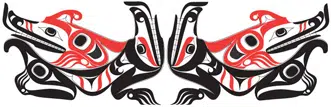
Wolves mate for life, and Nytom often uses the wolf to inspire his imagination in creating new designs. In the cultures of coastal peoples the wolf means a great deal, and is used in ceremonies to remind us to first take care of our elders and young, before ourselves. The design shows two wolves paired off, looking at each other and another wolf pair yet to be born.
Looking closely at this design, you can see two faces sharing one mouth. This represents the concept of people agreeing on an idea. There are four other faces incorporated in the design, which add their own interpretation to the concept of the talking circle. New ideas keep our cultural moving. Change is the constant. We embrace the change as we move ahead in our society.
The central figure in this design is a female entity, representing the matriarchal nature of our society. The women of coastal tribes were entrusted to hold, protect and preserve the names, songs and dances of their people. This high honor was bestowed upon women because they were entrusted with giving birth and being the primary caretakers of the children. Light heartedly, it is sometimes said, ‘you often see a Native man walking in front of a Native woman, and that is so the woman can tell the man which way to go.’ From a more serious perspective, it is known that men once lived severe lifestyles as hunters and warriors. It was important to recognize that if anything dreaded happened to the men, women would bear the heavy responsibility of keeping traditional cultures alive and flourishing.
The Makah have hunted whales on the open ocean since time and memorial. Whales have provided Makah people with food and valuable raw materials, and the practice continues to be a source of spiritual and ceremonial strength. In 1999, the Makah successfully hunted a grey whale, exemplifying the Makahs’ ability to control their own affairs and revitalize this rich culture as traditional coastal people.
There is no stronger bond in our culture than the one between two siblings. Two brothers are joined in this design by the spirit of their ancestors, the wolf.
Making his way through this world as an artist has given Nytom opportunities to convey the deep meaning of the teachings passed down by his elders. An important teaching of his grandparents was, “It is the hearts of others with values that help preserve a positive way of life.” In this design ‘Children Born of the Sun’ there appears the idea of the importance of teaching others the ways of our people. The Sun is representative of the Creator to many cultures throughout the world, and together with the Earth it transforms all living things. Nytom’s grandmother liked to say that “when you see a rainbow in the sky, it means someone’s prayers are being answered.” The faces represent the spirits of our ancestors and children not yet born. How fortunate we are to have the sense of responsibility to teach others the ways of our people. We are truly all Children Born of the Sun.
This is a special design Nytom has often revisited. It represents him and his partner living in the Circle of Life. After Nytom moved to Sequim, they had a Christmas holiday party for their friends, to enjoy each other’s company while sharing in the holiday spirit. They presented each guest with a copy of this design to show their appreciation for honoring the invitation.
As a young girl, Nytom’s mother knew a man called “Young Doctor” in the village of Neah Bay. He was an artist, carver, song maker and fisherman. His ability to make songs hadn’t come easy. Young Doctor walked bent over because of an accident in the woods. While he was caught under a tree, many songs came to him. Soon after he recovered from his accident, he brought out those songs for the people of Neah Bay. One song Nytom likes singing the most talks about frogs coming out of the ground in the spring. The people of Neah Bay sing this song at every community gathering. Like the frogs’ singing, it brings us together with a spirit of unity.
Nytom was commissioned to create a glass panel design for the entryway of the home of two friends who came together at a later time in life. The new moon is symbolic of a fresh start and a new love. A limited edition print was also created, and was handed out at a dinner to welcome family and friends to their home.
The Makah have been great whale hunters, and highly skilled at traveling a dangerous ocean in large dugout canoes. This design honors traditional oral history about the Thunderbird hunting the Whale. The Makah Nation is the only tribe in the continental United States for whom whaling is an original treaty right.
Certain First Nations of the Pacific Northwest Coast were great whalers. This design depicts the rivalry between ten whaling brothers. The oldest brother often made his prayers while on a sandbar, waiting for the incoming tide to cover his body. One day, while praying in this manner, his nine younger brothers attacked and killed him. During the fight, the oldest brother vowed that on an incoming tide his blood would find its way to their village. When his prediction came to pass, the people of the village avenged his murder by killing the remaining nine brothers. Many years later, the tragic history of this family was told by the elders at a village community gathering. The great-great-grandson of the brother who had been killed was asked by the elders to return home and take his rightful place among the Chiefs.
There are many events in nature that represent the cycle of life. Among many coastal tribes, the cycle of life is heralded by the spawning of the salmon each year. Young salmon migrate to their village far out in the ocean, and then after several years at sea endure an arduous journey fraught with dangers to return to their birth waters. The Salmon would always return because the tribes honored the Salmon People in their First Salmon Ceremonies. In doing so, they also teach the people to continue to overcome all odds–to survive and keep their traditional cultures alive.
People on the coast spent the spring, summer and fall gathering sustenance for the long harsh winters. The winter was for singing and dancing. The people gathered in their longhouses and related to one another by remembering and honoring their ancestors and sharing a genealogical relationship with the people of other houses. By naming the house posts, the people remembered their ancestors who were direct descendants of the house that had passed on before.The wolves in the design represent the Warrior Society among some of the coastal First Nations.
This design is based on one that was created during the last century. Upon returning to Neah Bay after an absence, a friend of Nytom’s shared this one among a collection of designs he once left behind. He has begun using this design for his brand.
Nine generations ago, First Peoples from Vancouver Island came by canoe to the village of Deeah (now known as Neah Bay) in search of a wife for their Chief. They waited just off the beach, hoping to be invited ashore. After singing in their canoes for a few days, a man threw his harpoon to the beach. Unimpressed, the Makah threw the harpoon back with a herring tied to the end of the shaft. A year later, the people from Vancouver returned to Neah Bay with two whales as gifts. The Makah people gave three women in marriage to the Chief. This was the beginning of blood relations between Nytom’s family and the people of Clayoquot Sound.